Why Discovery Is Important

As people begin to hear these new stories that affirm divine intention in creation and redemption, new possibilities arise. Maybe the fatalism their worldview demands is not the only option. Maybe the world did not come into existence by accidental forces. Maybe life can become more fruitful by journeying within this story.

Too often those who know the Biblical answer to the question, “What is truth?” get excited or impatient at this crucial point. We want to hurry these sojourners to the destination. We start to distill the story down to a summary and want them to accept reality upon the weight of our testimony. We want them to believe. Please, slow down and reconsider.

Will you always be there to hear these stories and choose how these people should live? Do you want their faith to rest on the foundation of your investigations of truth? Would it be better if they discover for themselves?

No, I am not going to tell you to butt out and leave them alone. But I am going to advise you to practice some restraint. Trust Papa God. Trust the Holy Spirit to bring conviction. Trust the hunger in their spirits to be “fed” by the bread of life!

Encourage them in a discovery process! Learn to rely on God and not yourself. Remember, these stories have to become their story. They have to see themselves within this journey to come to see how God really views them!

Worldview and DBS

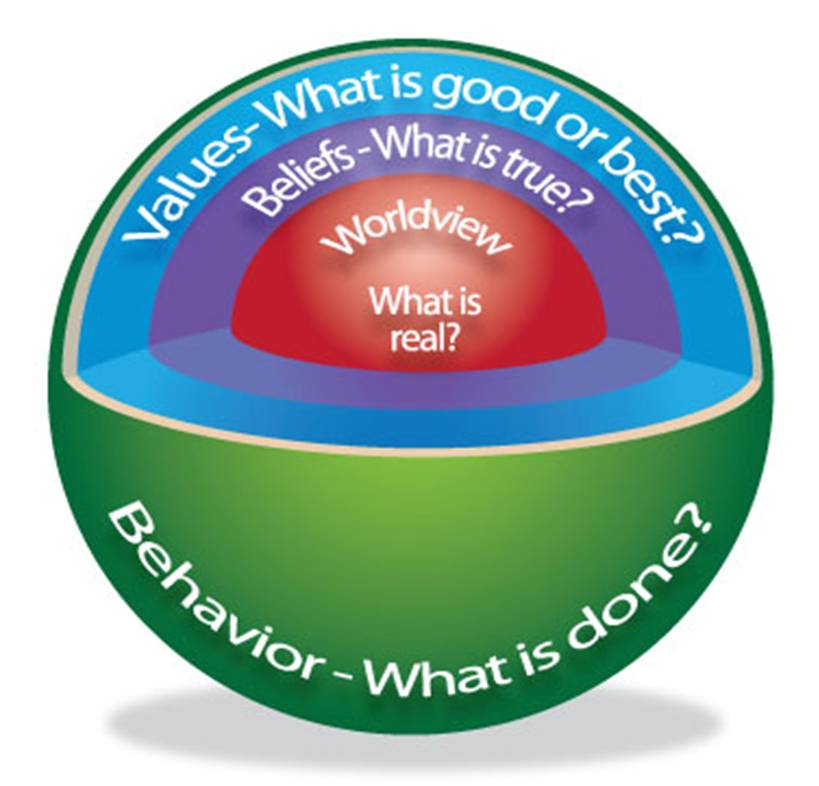
Now that we have taken a couple of weeks to survey some basic material you can learn in Sociology and/or Anthropology, let’s consider the value of Discovery Bible Studies in this context. Your sense of identity (Who am I?) impacts your beliefs, which shape your values and these direct your behavior.

That sense of identity arises from the stories that you grow up being told. No, not the occasional stories, but the ones that your parents accepted from their people group and keep passing on to the next generation.

When the creation/redemption story of the Bible shapes your worldview you approach life with crucial beliefs. Yes, you know that there is much brokenness in our world, because the sin of Adam brought long-term effects. But you also know that the God who created pursues people out of his great love and through his amazing grace.

As you walk with Israel, you travel the trajectory of Abraham’s faith. You know the roller coaster ride of faith and sin. You know what happens when the chosen forget their bridegroom. But you also sense the persevering love of God. In the midst of this journey you keep hearing the promises that He will do the unthinkable.

Like a Muslim man on the journey to knowing God, you marvel at God’s great love in sending the Suffering Servant! You experience shocked gratitude that this Servant would love you enough to take your stripes.

Little by little, God’s story re-writes your story! You begin to consider the impossible might be something He can pull off!

Worldview—What is Real?

Last we come to understand what is real for a people group. Their worldview answers four fundamental questions:

  1. Who am I?
  2. Where am I?
  3. What has gone wrong here?
  4. What can be done about it?

How do children receive their worldview from their parents? They receive it from the people and experiences in their lives. They especially receive it from stories these key people tell. We each have stories that shape how we see ourselves and our world. Change the guiding stories and a person’s worldview begins to shift.

The ultimate answers to these “What is real?” questions are found in the Creation to Christ stories of the Bible. Each person was created in God’s image. As Paul notes in Athens, “The God who made the world and everything in it…made every nation of men….Therefore since we are God’s offspring, we should not think that the divine being is like gold or silver or stone—an image made by man’s design and skill. In the past God overlooked such ignorance, but now he commands all people everywhere to repent. For he has set a day when he will judge the world with justice by the man he has appointed. He has given proof of this to all men by raising him from the dead” (Acts 17:24-31).

[NOTE: Diagram comes from Lloyd E. Kwast’s article “Understanding Culture,” pages 397-399 in the 2009 Perspectives Reader, which was edited by Ralph D. Winter and Steven C. Hawthore.]

Seek First the Kingdom

Some behaviors become practically automatic and carry little or no conscious connections to core values. But others are intentionally chosen to broadcast and reinforce the spiritual psycho-social weight of our beliefs and worldview.

For example, in Deuteronomy 6:4-9, God has Moses to call the people of Israel to be very deliberate in certain behaviors as a way of passing on a godly worldview:

Hear, O Israel: The Lord our God, the Lord is one. Love the Lord your God with all your heart and with all your soul and with all your strength. These commandments that I give you today are to be upon your hearts. Impress them on your children. Talk about them when you sit at home and when you walk along the road, when you lie down and when you get up. Tie them as symbols on your hands and bind them on your foreheads. Write them on the doorframes of your houses and on your gates.

Their core understanding of being in covenant with the Creator was to be of first importance in their lives. This reality should be overtly demonstrated, regardless of the level of intimacy someone encountered them (gates, doorpost, forehead, hand).

Through their words and other actions we observe what people determine to be good and what they deem best. Their choices reveal their values. What takes precedence in their lives?

Do you want a snapshot of your values? Open your checkbook register and/or your credit card statement. Scan through your day planner. Review your spiritual journal. These reflect how you choose to use your money, your time and/or your spiritual journey. What do you value?

Seek first the kingdom of God… was Jesus’ calling to those who would be his disciples. What you truly value drives your behavior.

[NOTE: Diagram comes from Lloyd E. Kwast’s article “Understanding Culture,” pages 397-399 in the 2009 Perspectives Reader, which was edited by Ralph D. Winter and Steven C. Hawthore.]

By Their Fruits You Will Know Them

When we first encounter a people group, we learn about them through their actions—the words they speak, the way they treat others, and their responses to the things that happen around them.

What they do—their behavior—gives us insight into their worldview. Their behavior around special times like the birth of a child, rites of passage, marriage and death are especially reflective of their worldview.

While some actions can lose their connections to values over time, there are others that continue to be directed by and reinforce deeply held values, beliefs and one’s worldview. For example, common greetings historically grew out of worldview. But over generations, many using these no longer have any sense of connection. They have become empty traditions.

Too often, missionaries of the past focused great attention on actions that were dubbed “Christian.” Calling people to imitate the behavior that is important back home, may actually encourage syncretism. Here a thin veneer of “Christian” behavior camouflages an unchanged worldview.

Certain behaviors are clearly antithetical to a biblical worldview (for example, idolatry). Others are not and can be adopted for the sake of winning people to Christ. Another category may have to be adapted to intentionally prompt spiritual discussions.

Next week we will consider the values we hold which shape our actions.


[NOTE: Diagram comes from Lloyd E. Kwast’s article “Understanding Culture,” pages 397-399 in the 2009 Perspectives Reader, which was edited by Ralph D. Winter and Steven C. Hawthore.]


Encourage One Another

Maybe I am close to being over jet lag. Spending a week where the time is twelve hours different than your home really messes with your biological clock. While I have been fairly productive, my thinking has not been clear enough to do much writing. So enough excuses, here’s one blog for the week:

Early in June I was introducing the oral Discovery Bible Study format to a house church group. The challenge was question # 8, “Which of the struggles mentioned earlier could we as a group do something to help one of us?” The problem was that the people in this group do not see each other much outside of their Tuesday night meetings. Some were even absent that night, and one was present through Skype, from his work. What can we do to minister to one of the group members?

One participant had shared that she needed a new job, and then she said, “What I really need is a better attitude about the job I have.” Another reminded the first one how excited she had been when she first got this job. We worked through the rest of the questions and the passage we studied and then came to number 8.

After I asked the question, the group reviewed what those challenges were that had been shared earlier. No one had a suggestion. Finally I asked the person who needed a new attitude if she could receive texts during work. She said, “Yes!” I proposed we all agree to text her each work day during the next week. Our texts were to encourage her to have a positive attitude about her work. All agreed to give it a try.

Five months later I still send out texts most work days. The original recipient of those texts is now a member of a six-person group. Most days my text is a verse that calls us to remember God’s character and the ways he blesses us. Last week I was unable to text because of being out of the country—I missed it. But that group was praying for me during my travels. God has knit our hearts together through this attempt to minister to one another. How are you putting what you learn into practice?

Today I just finished sharing the final verse from Psalm 145. This passage contains many powerful reminders of God’s goodness. It contains many calls to praise him and tell others of his deeds. Maybe you know a group of people to whom you could send such a text. Let’s take seriously the biblical call to encourage one another!

What May Come

Small Group DBSs

During the last four days I spent time with 700+ university students at the Global Mission Experience. It was hosted by Harding University this year and was held at Camp Tahkodah and at HUT. Here is the link to a one-minute trailer that was prepared for it:

http://www.youtube.com/watch?v=tkpheRKlMB0&feature=youtu.be

It was great to introduce these young people to Discovery Bible Studies. On Friday they worked through Luke 10:1-20 in small groups of 4-5. On Saturday those who returned watched a skit that dramatized what an attempt to find a Person of Peace might look like in a resistant community. Then they did another small group DBS looking at Deuteronomy 6:1-10.

Pray that several of these students will start Discovery groups on their respective campuses. These students came from across the U.S. and it is exciting to think about what God may do through them.

Hearing God

I am facilitating an adult Bible study class that is exploring the biblical material on “Hearing God.” We started by making a list of some of the ways God has spoken to his people. As Hebrews 1:1 points out, “In the past God spoke to our forefathers through the prophets at many times and in various ways…” One of those ways is dreams and visions. We have spent the last two weeks exploring the role of dreams in the life of Joseph, the son of Israel (Genesis 37, 40 & 41).

We found that others may become jealous of dreamers. Joseph’s ten brothers heard the dreams about bowing before him from the context of Israel’s favoritism toward Rachel’s son. The idea that this brother with the brightly colored cloak would rule over them riled them and they plotted to kill him. Some people naively assume that knowledge of the future will be such a great blessing.

In chapter 40 Joseph is not the dreamer, but gets to be the interpreter. As we discovered God through the narrative of Joseph, the chief cupbearer and baker we arrived at a question raised by a counselor in the class, “Do you see God as setting up and arranging these events to get Joseph to accomplish his purposes, or do you see God as becoming involved in the free choices of the people involved, when needed to channel them to accomplish his purpose?”

Sounds like a great place to get lost in the Calvin/Arminius debate.

Not trying to be a smart-aleck, I left the class with a different question—“So what?” No, I did not raise this as a way of implying this is an irrelevant question. Thinking about God’s sovereignty and exploring the ways he accomplishes his purpose in the affairs of individuals, people groups and even nations is a very appropriate aspect of the Joseph, Israel and Egypt narrative. The way I want the class (and you) to grapple with the “So what?” question is much more personal. I am not too concerned with whether you come out nearer either of the aforementioned theologians. The point I want you to ponder is how does your understanding of God’s nature affect your daily walk?

“What do you learn about God from this passage?” is the most important question we can ask of a text, in my studied opinion. If we approach Scriptures like a new yearbook (“Where is my picture in here?”), rather than as the record of God’s self-revelation, we are misusing them. Is God the puppeteer who only creates the appearance that his puppets have a life of their own, or does he really call them to join him in what he is seeking to accomplish and grant them some level of freedom to accept/reject that call, and then adapt based on those choices to make sure his purpose comes to pass?

For some, their answer to “So what?” is they arrive at some level of fatalism. God controls everything so it is futile to will to do anything, including responding in obedience to any calling he has placed on our lives (intentionally overstated)! At the opposite extreme there is the potential that one assumes, “I must grab the wheel and steer this vehicle!—it is all up to me.”

Does my understanding of God lead to either extreme? Is there a better understanding? Where I come out on this matters. It impacts how I hear God. It does not alter his intended meaning, but it greatly shapes my hearing. Remember that Jesus calls those with ears to hear. Grasping God’s nature greatly impacts how we hear, thus how we respond.

What are you hearing from God? How are you responding?
Pass It On

Four days ago I exposed more than 30 people to Discovery Bible Studies. We spent most of our three-hour gathering learning how to do an Oral DBS. But I also spent a few minutes talking about doing a written discovery process that is called a 3-column study. I gave each person a copy of a format that I have developed. One of the class members emailed me to ask for a digital copy of the form, so she would not have to re-create it. After I sent one to her in pdf she wrote back, explaining how she hopes to use this:

I have a lovely, bright and gifted 5th-grader who is having trouble understanding how important it is to have self-control over his tongue. I have been praying for him for a week or so, and I woke up in the middle of the night the other night with the idea to give him the 3-column bible study on a series of proverbs that have helped me immensely to control my own tongue. I believe it will be fruitful for this newly saved and baptized young man. I’ll let you know what God does!

Here is my reply to this teacher:

Years ago I was attempting to catalyze DBSs in the local jail. I started working with the one person I knew who was incarcerated there. He began a group study, to pass on what he was learning. When we knew he was soon to be released I asked him to pick the best candidate to keep it going. I started meeting with that guy, too. Every time the leader was about to be released we repeated this process.

Eventually I noticed generational degradation (copy a copy of a copy long enough and the quality deteriorates). It reached its lowest when the only guy who was an option had damaged his mental capacity greatly by using illegal substances—especially smoking wild mushrooms. His attention span and impulse control were negligible. I really agonized with whether or not I was wasting my time. But my bare-bones requirement for meeting with him weekly was whether or not he would do a 3-column study. He kept attempting to write one out, so I kept working with him. Months later this guy was transferred to the state penitentiary two hours away. Writing letters was our only contact. His last letter shared what he had recently discovered (all on his own) about the work of the Holy Spirit in his life. He wrote out the verses he had discovered, how he understood them and how he was trying to live them. It blew me away! I believe the Spirit “re-wired” some of his neural pathways. The 3-column studies became a spiritual discipline that the Spirit used to help him recover from some of the abuse he had done to himself.

While this young man you are working with is not that extreme an example, I praise God this approach may be a blessing for him! I pray it will equip him to experience Romans 12:1-2 “Therefore, I urge you, brothers, in view of God’s mercy, to offer your bodies as living sacrifices, holy and pleasing to God—this is your spiritual act of worship. Do not conform any longer to the pattern of this world, but be transformed by the renewing of your mind. Then you will be able to test and approve what God’s will is—his good, pleasing and perfect will.”

Two suggestions connected to this: keep the passages short (I suspect that you will already do that since you are going to use Proverbs) and do a 3-column study yourself, on the same passages. Show him your sheet when you read over his. Share with him how you are obeying–putting into practice—each passage. Model for him the process as well as teach him to do it and hold him accountable.

Blessings,
John King

Maybe you know a place where this process would be helpful. If so, just email me a request for the form (preacher at stonesriver.org) by replacing the spaces and “at” with the symbol. I will be happy to share this resource with you.

Pruning on Purpose

Are there areas in your life that need selective pruning? Are there places where you need to be opened up to the Son’s light so new growth can begin? Some growth can actually prevent fruitfulness. At a Disciple Making Movement gathering earlier this summer a guy at my table shared that he had recently planted a cherry orchard. He was being mentored by an older man who was very experienced. When he questioned how heavy the trees were being pruned, his mentor said, “If you want fruit, you have to hurt the tree!”

From the outside (un-experienced position) looking in, that is how some pruning appears. But the master gardener knows where strategic “hurting” needs to happen. This is guided by the purpose. With the azaleas, the issues were keeping them healthy, beautiful and within their space so their beauty could be appreciated without them encroaching on the sidewalks and parking spaces. For the cherry orchard, the purpose was not beautiful trees, but much fruit.

What is God’s purpose for your life? Does he want you as a trophy? Is he tending you as a beautiful ornament to bring joy into an otherwise drab world?

Is God’s purpose for you to show off an abundant harvest? Recognize that the pruning will be quite different when the goal is fruitfulness. While a tree with thousands of cherries might make a beautiful photograph and feed lots of birds, one with one-third the cherries will make much better pies. That is why the person tending the orchard will strategically remove most of the cherries early in their growth so more nutrition goes into each piece of fruit.

Discovery Bible Studies can open us up to light from the Son. Obedience to what we hear from God can prune away the good things that are enemies to great fruitfulness.