Reflecting on: “Barnabas” Encouraging Others

From: “The outside missionary is a “Paul,” preaching on the front lines among the unreached.”
To: “The outsider is far more effective as a “Barnabas,” discovering, encouraging and empowering a nearer-culture “Paul.””

People sent out as missionaries have often been encouraged to view themselves as the front-line worker, modeled after the Apostle Paul. We now realize that the far outsider can instead have the greatest impact by finding and partnering with cultural insiders or near neighbors who become the “Pauls” for their communities.

Note first that Barnabas was also a leader who “did the work” (Acts 11:22-26; 13:1-7). So movement catalysts need to first gain experience making disciples in their own culture and then work cross-culturally to find those “Pauls” from the focus culture whom they can encourage and empower.

Second, even these “Pauls” have to adjust their paradigms. The outside catalysts of a large movement in India studied Barnabas’ life to better understand their role. They then studied the passages with the initial “Pauls” of this movement. Those Paul-type leaders in turn realized that contrary to their cultural patterns (that the initial leader is always preeminent), they in turn wanted to become like Barnabas and empower those they discipled, to have an even greater impact. (Copied from: https://2414now.net/2020/09/22/mindshifts-in-movements-part-1/)

How much do you love the preeminence? Do you seek the limelight? Do you live for accolades?

Years ago I was in Spain doing some training. The wife of our host asked me a strange question: “Do you miss the spot-light?” I had just told her that I had been a Preacher for 31 years, prior to transitioning to my work with Final Command a few months earlier.

My surprise at her question was only surpassed by my honest answer, “No.” What had replaced my desire to be appreciated or applauded for a good sermon? Watching someone I was training and coaching becoming a Disciple Maker was giving me much greater joy.

Luke 10:21 says, At that time Jesus, full of joy through the Holy Spirit, said, “I praise you, Father, Lord of heaven and earth, because you have hidden these things from the wise and learned, and revealed them to little children. Yes, Father, for this is what you were pleased to do. What gave Jesus overflowing joy? Listening to the 72 telling about their success in finding Persons of Peace! Hearing them share stories of people who would be open to the King’s arrival into their communities.

While we cannot know for sure, it is possible these seventy-two others (Luke 10:1) were from the earlier ministry of the twelve when they were sent out imitating Jesus’ ministry of peace (Luke 9:1-2). Jesus does all the ministry in the first eight chapters of Luke. In chapter nine he sends out the twelve. Next in Luke 10 is this section on seventy-two others who become the ones he later calls little children. Recognize that you do not have to be part of the twelve to be sent out on a Jesus mission.

Maybe God has a bigger role for you than you can imagine. But maybe he wants that to come to pass through other people you can disciple, rather than through you personally doing most of the frontline work. Movements require many “daughters and sons of encouragement!” [NOTE: We often forget that “Barnabas” was actually a nickname for a man whose given name was Joseph (Acts 4:36). The nickname is used so often many of us never really learn his given name! Could this become your new nickname!]
Reflecting on: Setting the Stage for Multiplication

From: “My ministry is measured by my fruitfulness.”
To: “Are we faithfully setting the stage for multiplication (which may or may not happen during our ministry)?”

Growth is God’s responsibility (1 Cor. 3:6-7). Sometimes attempting to catalyze the first multiplying churches can take quite a few years. Field workers are told, “Only God can produce fruitfulness. Your job is to be faithful and obedient while expecting God to work.” We do our best to follow patterns of disciple-making multiplication found in the New Testament, and we trust the Holy Spirit to bring the growth. (Copied from: https://2414now.net/2020/09/22/mindshifts-in-movements-part-1/)

What if it takes someone besides you? What if it takes someone besides your team? What if you will not live to see the fruit multiplying? Would you still set the stage for multiplication? Abraham was promised offspring as numerous as the stars in the night sky or the sand on a seashore. Would he believe the promise of the one who first imagined multiplication–especially when his wife was barren? That was his crisis of faith. What is yours?

It was fifteen years ago, last month that I first imagined what a DMM in Middle Tennessee might look like. I gathered many groups and tried to use the breakthrough stories from India and Africa to plant a seed of possibility. Every effort crashed on a barrier reef. This morning I saw a new possibility of hope seated in a room. If God blesses that group with multiplication my role will be no more than a small footnote. At one level I am honestly sad at that thought. But God’s glory is a far more significant concern.

If you want to catalyze Movements you have to be good with the role of John the Baptist or Barnabas. Yes, Jesus is the Greater One! Yes, Paul gets more of the limelight, but even he reminds us that the Jesus way is the path of emptying self. Pride will get in the way of multiplication, every time.

Reflecting on: Mobilizing Extraordinary Prayer

From: “I pray.”
To: “We pray extraordinarily and mobilize others to pray.”

We aim to reproduce everything. Obviously personal prayer is crucial, but when faced with the overwhelming task of reaching entire communities, cities and people groups — we need to mobilize the prayer of many others. (Copied from: https://2414now.net/2020/09/22/mindshifts-in-movements-part-1/)

During 2015 I worked closely with a teammate to produce a set of five video segments which were designed to introduce African church leaders to the amazing fruitfulness God was blessing through Disciple Making Movements. In those videos we interviewed six global catalysts of some remarkable multi-generational movements located in six different nations of Africa.

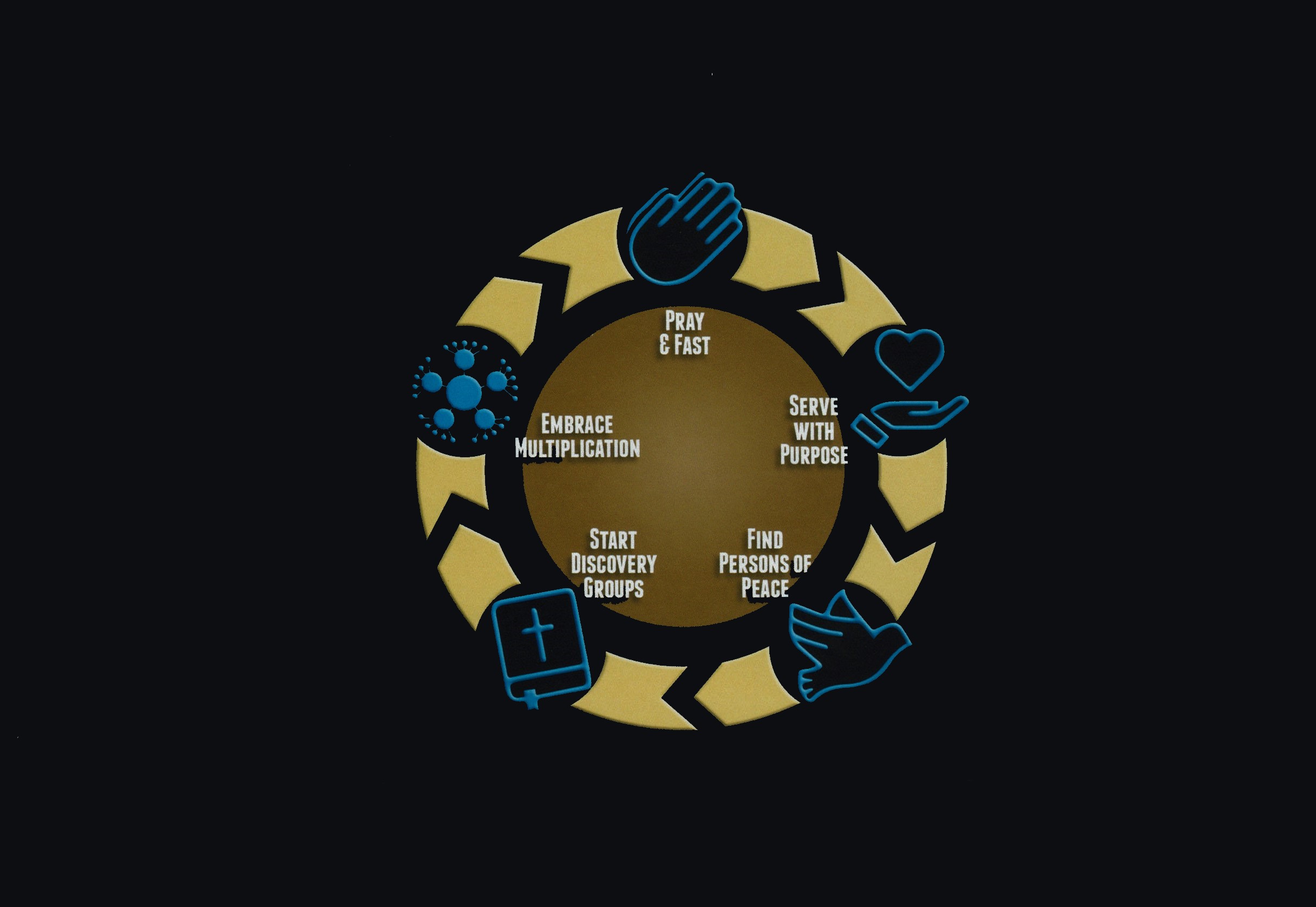
To prepare for the interviews we developed a set of questions each catalyst would be asked and those questions centered around five themes. Eventually we phrased those themes in the way presented in the following graphic:

Five Critical Elements for Starting Multiplying Groups

When we produced the video segments the names of these five topics were slightly different. But the starting point is always a call to pray & fast. Only God can cause Movements and our best way to tap into his desire to do that is via prayer, but it is a qualitatively different type of praying and that is why we connect it to fasting.

Extraordinary prayer is foundational to multiplication!

One of the differences is this type of prayer wrestles against our rank individualism. Movement praying involves mobilizing abundant intercession. It is always looking for those who already have a passion for intercession who are open to learning some of the foundational characteristics of DMM. Finding Persons of Peace and connecting with their family, friends and acquaintances is at the heart of Kingdom Multiplication. Jesus’ strategy was to hand-pick a group that he would pour most of his ministry effort into. Then, he sent the Holy Spirit in to empower them to do likewise. Multipliers discipling multipliers was his strategy.

But how do you find the right people? Pray & Fast. Abundant (extra-ordinary) intercession is essential. Who are you calling to join you in praying?

Reflecting on: “Who Else Needs to be a Part?”

From: “What can my group accomplish?”
To: “Who else can be a part of accomplishing this impossibly great task?”

This is similar to the mindshift [discussed in the last reflection]. Instead of focusing on the people and resources in our own church, organization, or denomination, we have realized we need to look at the entire body of Christ globally with all types of Great Commission organizations and churches. We also need to involve people with a variety of giftings and vocations to address the many efforts needed: prayer, mobilization, finances, business, translation, relief, development, arts, etc.  (Copied from: https://2414now.net/2020/09/22/mindshifts-in-movements-part-1/)

Many of us from the Global North have a strong institutional mindset that works counter to the kind of networking necessary to catalyze Movements. We focus too exclusively on our church or organization. We have been shaped too much by competition and/or fear. And often we are blind to how deeply entrenched these feelings really are.

Multi-generational multiplication is monumental! Only God can make Movements happen and he highly values humility and unity in those who will make themselves available to find what he is doing and join him.

One of the first Movements on the African continent was undermined by workers from another denomination discovering a network of simple churches that did not have buildings or paid pastors. Rather than doing some research into why that network of churches looked so different than what was expected, they offered to start supporting workers and helping to build meeting houses for churches. The new believers there shifted their energies and passions from evangelism and discipleship to gaining these “trappings” of the traditional Global North mindset.

When you look at all the resources and personnel required to see Movements, no single church or organization is large enough to cover all the bases. Intercessors, access ministries, front-line workers, Scripture resources and finances to get to multiplication are much greater than most people can imagine. We always need new people and organizations to see a people group reached with the Gospel, especially an Unreached People Group. And that need becomes even more demanding when it is an Unreached, Unengaged People Group.

One global catalyst said you have to give up your castle if you are going to see the Kingdom!

Reflecting on: “What must be done?”

From: “What can I do?”
To: “What must be done to see God’s Kingdom planted in this group of people (city, nation, language, tribe, etc.)?”

A training group was once discussing Acts 19:10 — how approximately 15 million people in the Roman province of Asia heard the word of the Lord in two years. Someone said, “That would be impossible for Paul and the original 12 believers in Ephesus – they would have had to share with 20,000 people a day!” That is the point – there is no way they could accomplish that. A daily training in the hall of Tyrannus must have multiplied disciples who multiplied disciples who multiplied disciples throughout the region. (Copied from: https://2414now.net/2020/09/22/mindshifts-in-movements-part-1/)

Some of us never get to the place of determining what we must personally do to get started. Others rush too quickly to take singular actions. This mindshift identifies another necessity—recognizing the work is far too large for any one person, team, organization and/or denomination. Movements come from God and Jesus has always called his followers to pray, “Your kingdom come, your will be done on earth as it is in heaven.” Being overwhelmed by what it will take to see the Somalis in a city reached pushes us to pray. It pushes us to fast. It forces us to begin exploring the question, “Who else needs to be involved in this effort?”

Many would-be DMM strategist has tried to involve others only to find it an effort in futility. Most of us reach the desperate place where we ask others to pray that we will have discernment in recognizing who to invest in and when to “shake the dust off our feet.” We have attempted to recruit lots of super-talented people and found them unwilling or unable to join us.

Do not give up if you have crashed on these rocks. Re-engage. Ask the Holy Spirit to help you make a list of more of what needs to be done to see this “beloved people group” becoming part of God’s Kingdom harvest force. One of your greatest needs is strong believers who are insiders of the people group who will be captured by a generational multiplication vision.

In addition to identifying a people group and starting to identify what it will take to see them reached, we need to pray that the Holy Spirit will connect us to people who can help. Barnabas is an incredible biblical character for DMM strategists to explore. We often are tempted to rush to Saul/Paul because we see him as the hero. He is the frontline preacher/teacher. He is the role model. But recognize it was Barnabas who left Antioch, found Saul and brought him into the place where a kingdom breakthrough started happening among the Gentiles!

Maybe you will be better served by casting yourself as Barnabas. Now ask yourself one question: “Who is my Saul/Paul?” Praying about this may eventually place you in the “second chair.” Are you willing to accept that role?

Who are the people in that neighborhood looking to as a leader? Who are their influencers? Who could “gossip the Gospel” and many would listen?

Part of the answer to the second question opening this post is “the right insider needs to become a strong disciple maker.”

Reflecting on “Expecting a ripe harvest”

From: “It can’t happen here!”
To: Expecting a ripe harvest.

Over the last 25 years people have often said: “Movements can start in those countries, but they can’t start here!” Today people point to the many movements in North India but forget this region was the “graveyard of modern missions” for 200+ years. Some said, “Movements can’t happen in the Middle East because that’s the heartland of Islam!” Yet many movements now thrive in the Middle East and throughout the Muslim world. Others said, “It can’t happen in Europe and America and other places with traditional churches!” Yet we now have seen a variety of movements start in those places as well. God loves to overcome our doubts. (Copied from: https://2414now.net/2020/09/22/mindshifts-in-movements-part-1/)

Back in 2011 I was travelling in West Africa with Jerry Trousdale. He had almost completed writing Miraculous Movements. His publisher wanted the book to appeal to the general Christian market so the book would spread DMM concepts much further than a typical missions book. To insure that, he required each chapter have strong stories that revealed any missiological principle which was being discussed. Jerry needed a few additional stories for a couple of the chapters. So one of the settings I sat in on were his nightly interviews of successful disciple makers who gathered with us.

At least two of the interviewees shocked me by confessing: “When we first went through the training with David Watson, I did not believe it would work here.” They each said, “I told [our leader], don’t do this. It might work in India, but this is West Africa.” These were men who had risked their lives for the last six years and had seen incredible miraculous breakthroughs and now they were repenting of their early lack of faith.

Disciple Making Movements (DMMs) require so many mindshifts that most people who are being introduced to them they discount the likelihood of ever seeing such amazing results. Yes, we read about it happening in Acts. Yes, we have read stories of the 1st and 2nd Great Awakenings, but we are almost hard-wired to discount God’s willingness to do the same today. The quicker we “come clean” on our disbelief, the quicker we can cry out, “Lord, I believe; help my unbelief!”

Generally the skeptical start out doubting the numbers of disciples being made. If they can get beyond that, then they question the orthodoxy of those being discipled (DMM practitioners are “surely cutting corners”). The last hold-out is the topic of this post: this culture is too resistant, far-gone, and or impossible to reach.

“Why not here?” is the first crack in this holdout. Beware when that question starts growing in your heart!

One practical step many DMM trainers use with individuals or teams who have begun to explore what it will take to expect a ripe harvest is to identify a pilot project. Begin praying about reaching a clearly identifiable region or people group in your community. Maybe it is a crime-riddled neighborhood, a trailer park or a government-funded apartment complex. The more this pilot project is unlike your home neighborhood, the more likely you are to acknowledge your need to “do things differently.” If you do not doubt that your standard approach will work there, you will not persevere to learning a new way forward.

Where does your heart ache with despair? Start praying and fasting for that place!

Reflecting on Discipling a Nation

From: Aiming to disciple individuals.
To: Aiming to disciple a nation.

In the Great Commission Jesus tells his disciples to “make disciples of panta ta ethne” (all ethne / every ethnos). The question is: “How do you disciple an entire ethnos?” The only way is through multiplication — of disciples who make disciples, churches that multiply churches, and leaders who develop leaders. (Copied from: https://2414now.net/2020/09/22/mindshifts-in-movements-part-1/)

Too often kingdom workers in the US focus either on isolated individuals or faceless masses. Jesus never does either of those. NEVER! He often interacts with individuals, but he does not isolate them from their family/friends and other social connections. Yes, I know there are individuals among the apostles about whom we know nothing of their families or friends, but we need to be careful about arguments from silence. We need to pay more attention to the information which is given to us.

Andrew brings Peter. James and John are brothers and their mother is among the women who helped fund Jesus’ itinerant travels. He heals Peter’s mother-in-law. Zacchaeus opens his household to Jesus, not just the dwelling where he resided. One of our great challenges is what I call rank individualism. Our culture places strong influence upon us to see ourselves as automatons.

A person’s extended family and friendship groups play a significant role in the biblical material when we read it without our individualistic glasses. Social groups are crucial to the undergirding of any society. In the Great Commission Jesus directs us to the highest level of social structure, the ethno-linguistic group. Tragically, our tendency to connect the translation of “ethna” (nation) to a geo-political entity has produced much misunderstanding, neglect and disobedience to the mission Jesus gives us.

But recognizing that “people groups,” or “ethno-linguistic groups” are what Jesus is referencing does not automatically simplify our responsibility. Disciple the Anglo-English speaking segment of the world is quite a calling. Disciple the Mandarin-speaking Chinese is massive. Disciple the Spanish-speaking Westerners is quite the calling. Here is a God-sized vision that most of us have ignored.

Multiplying the number of disciple makers is our only possible avenue for success. It is no surprise that is exactly where Jesus focused most of his ministry efforts in the four Gospels. We see him deploying the 12 in Matthew 10 and the 72 in Luke 10. He busied himself in discipling disciple makers and that is how a people group segment of our world is impacted.

In the desert regions of West Africa there is a people group with 1.2 million estimated population who live in five different countries. Historically they have been highly resistant to the Gospel, but God has birthed a remarkable Movement among them which we get to celebrate. One of the early evangelists among them came to faith while in prison. Upon his release he went to the pastor of a traditional church who sent him back to his family rather than welcoming him into that community of faith. Because his relatives saw a remarkable transformation in his life, they were open to reading and discussing the Bible as family. God is bringing forth a harvest of thirty-fold, sixty-fold even one-hundred-fold today.

Increasing numbers of people are coming to faith in Jesus and reaching their families, too, because this leader did not extract this new believer from his household, but trained and coached him to obey Jesus by becoming a disciple maker. I praise God that he came to faith through Discovery and was not side-tracked by his own efforts to join a body of believers and alienate his household without them getting the opportunity to discover the God who brings radical transformation!

Reflecting on “A God-sized Vision”

From: “This is possible; I can see a path to accomplishing my vision.”
To: A God-sized vision, impossible apart from His intervention. Waiting on God for his guidance and power.

One of the main reasons so many CPMs seem to have started in modern times is that people accepted a God-sized vision of focusing on reaching entire people groups. When faced with the task of reaching an unreached group consisting of millions of people it becomes obvious that a worker cannot accomplish anything on their own. The truth that “apart from me you can do nothing” applies to all our endeavors. However, if we have a smaller goal it’s easier to work as if fruit depends on our efforts rather than on God’s intervention. (Copied from: https://2414now.net/2020/09/22/mindshifts-in-movements-part-1/)

A verse from Proverbs might come to mind as we reflect on this Mindshift: “When there is no clear prophetic vision, people quickly wander astray. But when you follow the revelation of the word, heaven’s bliss fills your soul.” (Proverbs 29:18, The Passion Translation). Note how the Message restates this proverbial saying: “If people can’t see what God is doing, they stumble all over themselves; But when they attend to what he reveals, they are most blessed.” (Proverbs 29:18, The Message).

When you reflect on your city, campus or beloved people group what do you think? Can you envision what a blessing they would become to other groups? Does your heart overflow with joy pondering how many people they will reach with the Gospel?

One of my friends who is a cross-cultural missionary in East Africa wrote the following in reflecting on this shift: “This one was a challenge for our team. I like the idea of having a God-sized vision, but when we tried to set massive goals we just felt like we were pulling numbers out of the air. I think this one deserves even more prayer and fasting until God really lays the vision on your heart.” Yes, the vision we seek to see become a reality must shape our goals, but I think he identifies why many of us are scared off by a God-sized vision. We set massively impossible goals for ourselves. How can 12 reach millions?

The answer is not to create smaller goals for ourselves, so much as it is to clearly acknowledge and communicate with God that we realize he must do the “heavy lifting.” A God-sized vision for your neighborhood will only become a reality when God’s resources are mobilized. But you are one of his resources. Will your heart learn to beat in rhythm with His heart? If so, then there will be realistic goals you can formulate for yourself which align with the vision he is giving you for them.

Consider a Campus ministry to a university with an enrollment of 11,638. When you check you discover that they have 3,600 beds in their on-campus housing. Either number will be too large for any team to reach, especially with the turnover expectations. But one DMM minded catalyst has prayed fervently and arrived at the idea of raising up 80 disciple makers. Why 80? There are forty floors in those campus dorms and he believes that Jesus’ strategy of sending workers out in pairs has incredible value.

His goal is still a steep hill to climb. It will stretch him and his team greatly. While 80 is more manageable than 3,600 or 11,638, it still is a stretch. But it also shapes the kind of training he is doing in his attempts to raise up 80 (by the way, he says they started with 3, then 5 and is up to 8, so there still is much to be done). The goal is to equip everyone trained to be able to start a Discovery Group in a way that other students not only come to faith, but they are simultaneously equipped to start new groups with other people. Generational multiplication is not fast on the front end. It actually can be rather slow, but it carries in its DNA the explicit goal of increasing the capacity to equip others to facilitate new groups in ways participants can be equipped to start new groups.

Global DMMers were pushed to develop simpler strategies because our desire was to raise up disciple makers more quickly than we had previously thought possible!

Reflecting on “Mindshifts in Movements”

Before reading this post, I encourage you to click on the following link and read the article to which I am responding: https://2414now.net/2020/09/22/mindshifts-in-movements-part-1/. This was written by two authors. One I know well and the other I have heard great things about her. I highly commend this article and the second portion which is also available.

I copied the article and sent it out to a host of people who I know who have an interest in seeing Movements begin among people groups here in North America, too. With the article I asked some questions: What paradigm shifts were the hardest for you to make? Which shift are you still challenged to make? Which ones do pastors and other church leaders struggle with the most (in your experience)? I am not wanting you to confine yourself to the shifts mentioned below. Maybe your biggest challenge has not been listed, yet?

My goal was to provoke deep thinking and reflection. It was to challenge these would-be catalysts to identify the highest hurdles to Multiplication thinking and practices. What deeply worn ruts in traditional Christian thinking hold us back, or keep us doing what we have always done?

If you went to that link and explored the article, you have seen the list of mindshifts we will need to make to see Movements begin. I plan to explore each of these over several weeks. Some of them I will be able to share some of what my friends wrote to me about how they have been challenged in the same area. My prayer is these thoughts will be valuable to you and assist you in making changes in your behaviors and practices, too. Thinking which remains void of action will not be fruitful.

Critical Elements for Starting (pt. 5)

  1. Embrace Multiplication: As God blesses this process, churches multiply and the kingdom spreads out.  In order to allow this process to work, some ideas have to be embraced, and our paradigms must shift.  As I’ve said, this method is a tool for anyone who wants to spread the gospel.  Here’s the possible rub, this system is empowered by God, and not overly controlled by the church.  Through prayer, and obedience-based disciple making, the church allows these groups to spread as the Holy Spirit leads.  This process may start a church we don’t even know about, and that’s okay. Multiplication comes when we learn to constantly search out and disciple two types of people—Persons of Peace and Multipliers.
  • Multipliers—these are believers who will be open to learning how to reach people in bunches (like the way you harvest bananas and grapes), not just one by one. Almost all Western evangelistic strategies focus on one on one approaches. But we have found that using these can actually increase the resistance of people groups with strong family and friendship ties. Multipliers will be open to learning group strategies. They are willing to shift their focus toward discipling disciple makers. They are willing to learn to use approaches which can easily be reproduced by the people they are reaching. Multipliers are very coachable.
  • Scriptures:
    • John 15:1-17 (Those who abide in Jesus bear fruit, vs. 2; much fruit, vs. 5; and fruit that will last, vs. 16).
    • Matthew 28:1-10, 16-20 (The message of the resurrection culminates in the Great Commission).
    • Acts 2:42-47; 4:1-4; 5:12-16; 6:1, 7 (These passages reveal the growing spread of the gospel of the kingdom).
    • Acts 8:1-3 & 11:19-30 (The gospel is spread by ordinary disciples as their response to persecution).
    • Acts 19:1-20 (Paul and his team see the gospel spread throughout the Roman province of Asia from Ephesus).
  • Activities:
    • Guide church leaders through an exploration of what will be needed to replicate themselves and their ministries.
    • Brainstorm what will be required for our church to plant “Rabbit Churches” (i.e., those which rapidly multiply).
    • Share in your cohort the Paradigm Shift which has been most difficult for you to make. Pray for one another to be patient with those who are just starting down the road of embracing multiplication.
    • Celebrate successes!