DBS Helps Cross-cultural Communications

Cross-cultural communication is a challenge at best! Just ask wives and husbands how many times they realized their spouse did not hear what they intended to communicate.

In every cross-cultural conversation there is a sender and a receiver. The sender uploads what she/he intends to communicate, but their message is always encoded from within their cultural context (yes, this more closely approximates that of the receiver the more fluent their language skills are). Then the receiver downloads the message and filters it through his/her ethno-linguistic cultural grid. But the process is also impacted by “noise.”

The only way to assess what is understood is to ask for feedback. “What did you understand me to just say?” is a great way to seek clarity. When this person shares what they heard, then you can attempt to overcome the effects of noise and the differences in the ways we utilize words/phrases cross-culturally.

One of the great beauties of Discovery Bible Studies (when the stories are being heard in the heart tongue) is the passage is not being explored cross-culturally. Yes, I know that Scriptures were written from within and for other cultures (e.g., pre-exilic Hebrew, post-exilic Hebrew, 1st century Judeo-Christian, 1st century Gentile Christian, etc.) but it is not going through the additional cultural grid of the cross-cultural missionary.

The Word of God illuminated by the Spirit of God is enough to produce the people of God!
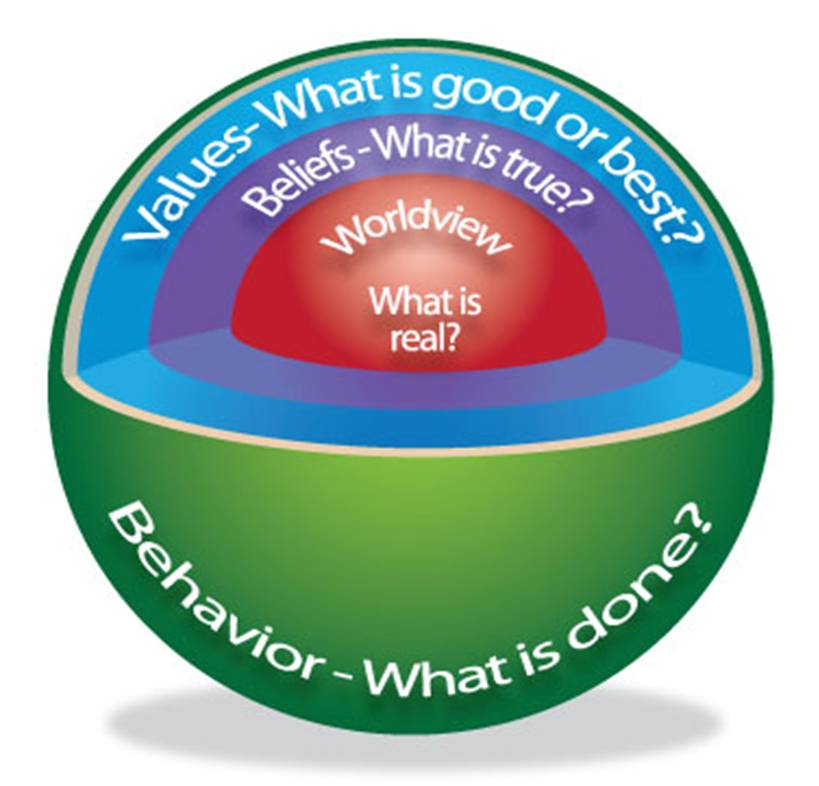
Worldview—What is Real?

Last we come to understand what is real for a people group. Their worldview answers four fundamental questions:

  1. Who am I?
  2. Where am I?
  3. What has gone wrong here?
  4. What can be done about it?

How do children receive their worldview from their parents? They receive it from the people and experiences in their lives. They especially receive it from stories these key people tell. We each have stories that shape how we see ourselves and our world. Change the guiding stories and a person’s worldview begins to shift.

The ultimate answers to these “What is real?” questions are found in the Creation to Christ stories of the Bible. Each person was created in God’s image. As Paul notes in Athens, “The God who made the world and everything in it…made every nation of men….Therefore since we are God’s offspring, we should not think that the divine being is like gold or silver or stone—an image made by man’s design and skill. In the past God overlooked such ignorance, but now he commands all people everywhere to repent. For he has set a day when he will judge the world with justice by the man he has appointed. He has given proof of this to all men by raising him from the dead” (Acts 17:24-31).

[NOTE: Diagram comes from Lloyd E. Kwast’s article “Understanding Culture,” pages 397-399 in the 2009 Perspectives Reader, which was edited by Ralph D. Winter and Steven C. Hawthore.]

Walk Your Talk

Below the community values of a people group are their beliefs. Here we take note of what they believe to be true:

  1. What is truth?
  2. What are their core beliefs?
  3. Are they fatalistic or do they believe they can produce change in their world?

A group’s perception of reality always colors their experiences. If they believe that their lives are always overwhelmed by forces outside their control, then they usually tend toward fatalism. Change is viewed as impossible because these forces dominate their experience—in their mind.

We need to recognize that what people say their beliefs are and this level of their sense of self are rarely identical. Professed beliefs can sometimes be a cover to protect a person from cultural suicide. Here the individual disagrees with his/her society, but knows that it will be dangerous to openly proclaim personal beliefs. For others, professed beliefs are ideals that are held up as goals to strive for because they are not yet fully internalized.

What would an objective witness to your daily walk say you believe? Does your daily life evidence what you profess? Are you a woman/man of integrity? Do you walk your talk?

[NOTE: Diagram comes from Lloyd E. Kwast’s article “Understanding Culture,” pages 397-399 in the 2009 Perspectives Reader, which was edited by Ralph D. Winter and Steven C. Hawthore.]

Seek First the Kingdom

Some behaviors become practically automatic and carry little or no conscious connections to core values. But others are intentionally chosen to broadcast and reinforce the spiritual psycho-social weight of our beliefs and worldview.

For example, in Deuteronomy 6:4-9, God has Moses to call the people of Israel to be very deliberate in certain behaviors as a way of passing on a godly worldview:

Hear, O Israel: The Lord our God, the Lord is one. Love the Lord your God with all your heart and with all your soul and with all your strength. These commandments that I give you today are to be upon your hearts. Impress them on your children. Talk about them when you sit at home and when you walk along the road, when you lie down and when you get up. Tie them as symbols on your hands and bind them on your foreheads. Write them on the doorframes of your houses and on your gates.

Their core understanding of being in covenant with the Creator was to be of first importance in their lives. This reality should be overtly demonstrated, regardless of the level of intimacy someone encountered them (gates, doorpost, forehead, hand).

Through their words and other actions we observe what people determine to be good and what they deem best. Their choices reveal their values. What takes precedence in their lives?

Do you want a snapshot of your values? Open your checkbook register and/or your credit card statement. Scan through your day planner. Review your spiritual journal. These reflect how you choose to use your money, your time and/or your spiritual journey. What do you value?

Seek first the kingdom of God… was Jesus’ calling to those who would be his disciples. What you truly value drives your behavior.

[NOTE: Diagram comes from Lloyd E. Kwast’s article “Understanding Culture,” pages 397-399 in the 2009 Perspectives Reader, which was edited by Ralph D. Winter and Steven C. Hawthore.]

By Their Fruits You Will Know Them

When we first encounter a people group, we learn about them through their actions—the words they speak, the way they treat others, and their responses to the things that happen around them.

What they do—their behavior—gives us insight into their worldview. Their behavior around special times like the birth of a child, rites of passage, marriage and death are especially reflective of their worldview.

While some actions can lose their connections to values over time, there are others that continue to be directed by and reinforce deeply held values, beliefs and one’s worldview. For example, common greetings historically grew out of worldview. But over generations, many using these no longer have any sense of connection. They have become empty traditions.

Too often, missionaries of the past focused great attention on actions that were dubbed “Christian.” Calling people to imitate the behavior that is important back home, may actually encourage syncretism. Here a thin veneer of “Christian” behavior camouflages an unchanged worldview.

Certain behaviors are clearly antithetical to a biblical worldview (for example, idolatry). Others are not and can be adopted for the sake of winning people to Christ. Another category may have to be adapted to intentionally prompt spiritual discussions.

Next week we will consider the values we hold which shape our actions.


[NOTE: Diagram comes from Lloyd E. Kwast’s article “Understanding Culture,” pages 397-399 in the 2009 Perspectives Reader, which was edited by Ralph D. Winter and Steven C. Hawthore.]


How Foolish?

In his Commentary on the Whole Bible, Matthew Henry popularized the aphorism, “None so blind as those that will not see.” No, this exact statement is not found in scriptures, but it certainly is consistent with Jesus’ explanation for why he used parables (Matthew 13:13).

The problem with blind spots is we often do not know we have them—we are blind to our blind spots. The sign at the top of this page well illustrates such dullness. But before we become too haughty toward the originators, many spiritual teachers need to ponder the issue of literacy.

Can the illiterate people in your community easily come to know God through your ministry? Has your ministry style been shaped more by the printing press than by the heard Word? Revelation 1:3 says,Blessed is the one who reads the words of this prophecy, and blessed are those who hear it and take to heart what is written in it, because the time is near.”

A missionary friend in Equador recently shared, “Given that over half of the people we are ministering to here cannot read, I have noticed that their ‘groomed nature’ is not of being able to retain what they are learning by memorizing from not only themselves not reading, but when others are merely reading Scriptures, etc. However, when they hear a story, they remember it down to the tiniest detail. That speaks to my heart and shows me a fruitful way to minister to them by storytelling—reading some Scripture verses and incorporate a Biblical story that brings to life the concept or set of verses being taught. That’s one of the many wonderful things about Jesus! He doesn’t limit ways in which we can share Him!”

Make sure your teaching method does not require people to do what is actually impossible for them to accomplish. The Word was accessible to the illiterate long before the printing press was invented! Also, I encourage you to remember that three-fourths it was recorded in narrative format. God knows what He is doing! Let’s imitate Him!