Why Discovery Is Important

As people begin to hear these new stories that affirm divine intention in creation and redemption, new possibilities arise. Maybe the fatalism their worldview demands is not the only option. Maybe the world did not come into existence by accidental forces. Maybe life can become more fruitful by journeying within this story.

Too often those who know the Biblical answer to the question, “What is truth?” get excited or impatient at this crucial point. We want to hurry these sojourners to the destination. We start to distill the story down to a summary and want them to accept reality upon the weight of our testimony. We want them to believe. Please, slow down and reconsider.

Will you always be there to hear these stories and choose how these people should live? Do you want their faith to rest on the foundation of your investigations of truth? Would it be better if they discover for themselves?

No, I am not going to tell you to butt out and leave them alone. But I am going to advise you to practice some restraint. Trust Papa God. Trust the Holy Spirit to bring conviction. Trust the hunger in their spirits to be “fed” by the bread of life!

Encourage them in a discovery process! Learn to rely on God and not yourself. Remember, these stories have to become their story. They have to see themselves within this journey to come to see how God really views them!
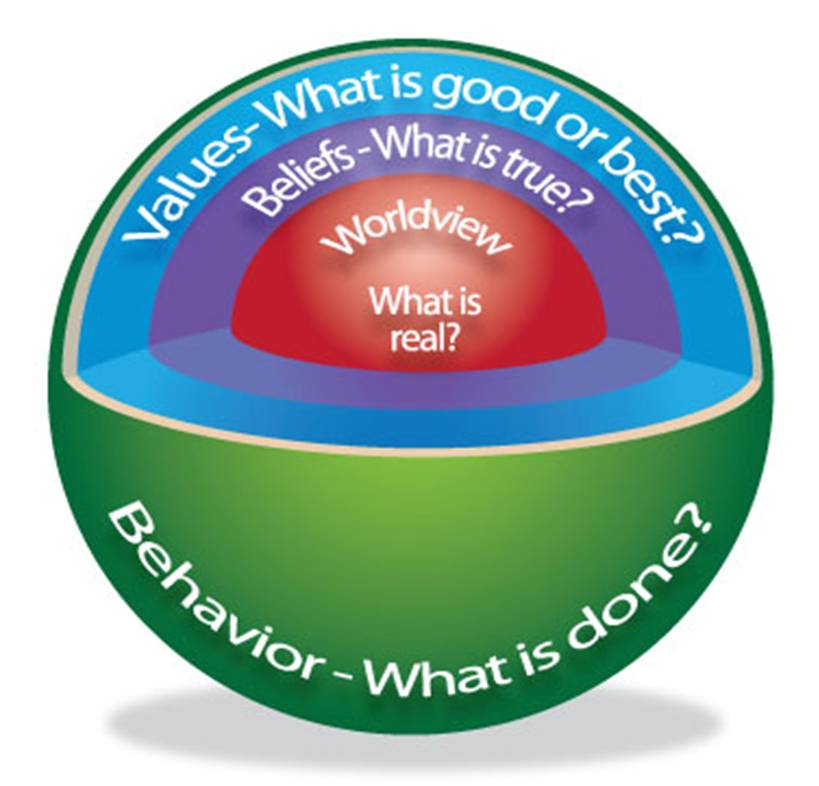
Worldview and DBS

Now that we have taken a couple of weeks to survey some basic material you can learn in Sociology and/or Anthropology, let’s consider the value of Discovery Bible Studies in this context. Your sense of identity (Who am I?) impacts your beliefs, which shape your values and these direct your behavior.

That sense of identity arises from the stories that you grow up being told. No, not the occasional stories, but the ones that your parents accepted from their people group and keep passing on to the next generation.

When the creation/redemption story of the Bible shapes your worldview you approach life with crucial beliefs. Yes, you know that there is much brokenness in our world, because the sin of Adam brought long-term effects. But you also know that the God who created pursues people out of his great love and through his amazing grace.

As you walk with Israel, you travel the trajectory of Abraham’s faith. You know the roller coaster ride of faith and sin. You know what happens when the chosen forget their bridegroom. But you also sense the persevering love of God. In the midst of this journey you keep hearing the promises that He will do the unthinkable.

Like a Muslim man on the journey to knowing God, you marvel at God’s great love in sending the Suffering Servant! You experience shocked gratitude that this Servant would love you enough to take your stripes.

Little by little, God’s story re-writes your story! You begin to consider the impossible might be something He can pull off!

Worldview—What is Real?

Last we come to understand what is real for a people group. Their worldview answers four fundamental questions:

  1. Who am I?
  2. Where am I?
  3. What has gone wrong here?
  4. What can be done about it?

How do children receive their worldview from their parents? They receive it from the people and experiences in their lives. They especially receive it from stories these key people tell. We each have stories that shape how we see ourselves and our world. Change the guiding stories and a person’s worldview begins to shift.

The ultimate answers to these “What is real?” questions are found in the Creation to Christ stories of the Bible. Each person was created in God’s image. As Paul notes in Athens, “The God who made the world and everything in it…made every nation of men….Therefore since we are God’s offspring, we should not think that the divine being is like gold or silver or stone—an image made by man’s design and skill. In the past God overlooked such ignorance, but now he commands all people everywhere to repent. For he has set a day when he will judge the world with justice by the man he has appointed. He has given proof of this to all men by raising him from the dead” (Acts 17:24-31).

[NOTE: Diagram comes from Lloyd E. Kwast’s article “Understanding Culture,” pages 397-399 in the 2009 Perspectives Reader, which was edited by Ralph D. Winter and Steven C. Hawthore.]

Walk Your Talk

Below the community values of a people group are their beliefs. Here we take note of what they believe to be true:

  1. What is truth?
  2. What are their core beliefs?
  3. Are they fatalistic or do they believe they can produce change in their world?

A group’s perception of reality always colors their experiences. If they believe that their lives are always overwhelmed by forces outside their control, then they usually tend toward fatalism. Change is viewed as impossible because these forces dominate their experience—in their mind.

We need to recognize that what people say their beliefs are and this level of their sense of self are rarely identical. Professed beliefs can sometimes be a cover to protect a person from cultural suicide. Here the individual disagrees with his/her society, but knows that it will be dangerous to openly proclaim personal beliefs. For others, professed beliefs are ideals that are held up as goals to strive for because they are not yet fully internalized.

What would an objective witness to your daily walk say you believe? Does your daily life evidence what you profess? Are you a woman/man of integrity? Do you walk your talk?

[NOTE: Diagram comes from Lloyd E. Kwast’s article “Understanding Culture,” pages 397-399 in the 2009 Perspectives Reader, which was edited by Ralph D. Winter and Steven C. Hawthore.]

Seek First the Kingdom

Some behaviors become practically automatic and carry little or no conscious connections to core values. But others are intentionally chosen to broadcast and reinforce the spiritual psycho-social weight of our beliefs and worldview.

For example, in Deuteronomy 6:4-9, God has Moses to call the people of Israel to be very deliberate in certain behaviors as a way of passing on a godly worldview:

Hear, O Israel: The Lord our God, the Lord is one. Love the Lord your God with all your heart and with all your soul and with all your strength. These commandments that I give you today are to be upon your hearts. Impress them on your children. Talk about them when you sit at home and when you walk along the road, when you lie down and when you get up. Tie them as symbols on your hands and bind them on your foreheads. Write them on the doorframes of your houses and on your gates.

Their core understanding of being in covenant with the Creator was to be of first importance in their lives. This reality should be overtly demonstrated, regardless of the level of intimacy someone encountered them (gates, doorpost, forehead, hand).

Through their words and other actions we observe what people determine to be good and what they deem best. Their choices reveal their values. What takes precedence in their lives?

Do you want a snapshot of your values? Open your checkbook register and/or your credit card statement. Scan through your day planner. Review your spiritual journal. These reflect how you choose to use your money, your time and/or your spiritual journey. What do you value?

Seek first the kingdom of God… was Jesus’ calling to those who would be his disciples. What you truly value drives your behavior.

[NOTE: Diagram comes from Lloyd E. Kwast’s article “Understanding Culture,” pages 397-399 in the 2009 Perspectives Reader, which was edited by Ralph D. Winter and Steven C. Hawthore.]

By Their Fruits You Will Know Them

When we first encounter a people group, we learn about them through their actions—the words they speak, the way they treat others, and their responses to the things that happen around them.

What they do—their behavior—gives us insight into their worldview. Their behavior around special times like the birth of a child, rites of passage, marriage and death are especially reflective of their worldview.

While some actions can lose their connections to values over time, there are others that continue to be directed by and reinforce deeply held values, beliefs and one’s worldview. For example, common greetings historically grew out of worldview. But over generations, many using these no longer have any sense of connection. They have become empty traditions.

Too often, missionaries of the past focused great attention on actions that were dubbed “Christian.” Calling people to imitate the behavior that is important back home, may actually encourage syncretism. Here a thin veneer of “Christian” behavior camouflages an unchanged worldview.

Certain behaviors are clearly antithetical to a biblical worldview (for example, idolatry). Others are not and can be adopted for the sake of winning people to Christ. Another category may have to be adapted to intentionally prompt spiritual discussions.

Next week we will consider the values we hold which shape our actions.


[NOTE: Diagram comes from Lloyd E. Kwast’s article “Understanding Culture,” pages 397-399 in the 2009 Perspectives Reader, which was edited by Ralph D. Winter and Steven C. Hawthore.]


Church–How Can We Do It There?

Recently a friend who works in Asia wrote, “I’m always surprised to hear people tell me they don’t know anything about Jesus!!! Absolutely nothing! Today three more souls got to hear the Good News for the first time. I’m so honored to be the one to tell them…” This frequent occurrence should challenge us and remind us how blessed we are if we live in a country with freedom of religion and grew up in godly homes.

I urge you to open your eyes this week, especially when you visit public places. Take note of the people who are obviously from other parts of our world. No, I do not want to fuel prejudice in your hearts; I ask you to consider the possibility that God has them here so they can learn to trust in Jesus and be equipped to start disciple making movements in their home nations.

For such movements to happen back home, many of these folks will have to learn a different model of church than we experience here in the U.S. Mufreesboro is home to a fairly large ELL (English Language Learning) School. More of the students come from Saudi Arabia and China than any other nations. While these students live in our city, it will be wonderful for them to come to know Jesus. But how much more valuable their time will be if they are equipped to facilitate church planting movements back home. It will require training them to “do church” in ways that will not make them a target when they return. If we deeply connect them to church as we know it, we make it more likely they never return because they know such is not possible where they call home.

Encourage One Another

Maybe I am close to being over jet lag. Spending a week where the time is twelve hours different than your home really messes with your biological clock. While I have been fairly productive, my thinking has not been clear enough to do much writing. So enough excuses, here’s one blog for the week:

Early in June I was introducing the oral Discovery Bible Study format to a house church group. The challenge was question # 8, “Which of the struggles mentioned earlier could we as a group do something to help one of us?” The problem was that the people in this group do not see each other much outside of their Tuesday night meetings. Some were even absent that night, and one was present through Skype, from his work. What can we do to minister to one of the group members?

One participant had shared that she needed a new job, and then she said, “What I really need is a better attitude about the job I have.” Another reminded the first one how excited she had been when she first got this job. We worked through the rest of the questions and the passage we studied and then came to number 8.

After I asked the question, the group reviewed what those challenges were that had been shared earlier. No one had a suggestion. Finally I asked the person who needed a new attitude if she could receive texts during work. She said, “Yes!” I proposed we all agree to text her each work day during the next week. Our texts were to encourage her to have a positive attitude about her work. All agreed to give it a try.

Five months later I still send out texts most work days. The original recipient of those texts is now a member of a six-person group. Most days my text is a verse that calls us to remember God’s character and the ways he blesses us. Last week I was unable to text because of being out of the country—I missed it. But that group was praying for me during my travels. God has knit our hearts together through this attempt to minister to one another. How are you putting what you learn into practice?

Today I just finished sharing the final verse from Psalm 145. This passage contains many powerful reminders of God’s goodness. It contains many calls to praise him and tell others of his deeds. Maybe you know a group of people to whom you could send such a text. Let’s take seriously the biblical call to encourage one another!

Equipping the Saints

Tuesday I mentioned that it has never been easier to go to the nations than it is right now. Business creates a climate where it is possible to travel to untold parts of our planet. On my flight from Dallas to Tokyo I sat next to a man who works in the health industry. His company is developing a portable lab for doing all kinds of specialized blood tests—one you can carry in your pants pocket! Needless to say, this resource will be incredibly valuable! But the best thing is he is a believer and he was traveling with two other men from the church where he is involved. These two focus on international missions.

This guy’s business travels will likely give him access the other two men cannot go. There will be places in the Middle East that will be strongly interested in this medical device, once the FDA approval is completed. Wherever this man goes he will be a kingdom representative! The possibilities are endless.

Sadly, this man was jealous of the other two guys being able to spend all their time focused on “spiritual” matters. What can be more spiritual than providing doctors with instant information about cancer markers or heart enzymes? Here is a man who needs to learn how to catalyze Disciple Making Movements and use the access his business will grant him for kingdom advances. I am excited to think about following up with him when I return home. What a beautiful opportunity to swap business cards! When I told him why I was traveling he said, “It is exciting to hear of so many things that God is doing in our world!” Yes, it is!

Obeying Jesus

Globalization conjures up many ideas to diverse people. For some, it is the greatest curse to our world because it violates our isolationist tendencies. To others it is a wonderful way to get cheap products. Years ago I asked the folks at Stones River Church to reach up and grab the tag in the collar of their shirt/blouse and show it to a person near them. Then I asked them to share the names of the countries where these items had been manufactured. There were more than 30 nations in a group of about 100 people. Globalization made that possible.

My thoughts on globalization are taking a different angle as I write. I am sitting in a McDonalds in the Bangkok airport, waiting on my next flight. To get here I had stops in Dallas and Tokyo. It is sort of crazy to think about the opportunities available today to take the gospel to the nations. Obeying Jesus’ commission to “Go make disciples of all the nations…” has never been easier than right now!

This week I will be training Buddhist background believers in Disciple Making strategies. The goal of organizer of this training is that some of them will join him in his passion for reaching Muslims who live in Southern Thailand. Only God can pull this one off! But then again, He has always had a soft place in his heart for reaching the nations.

I am convinced God’s decision to confound the language of the people and force the development of so many cultures (Genesis 11) was an act of God’s grace. He knew that their rebellious spirit was intent on using blessings for self-aggrandizement and left undeterred, they would bring horrible punishment upon themselves. He prevented their wicked purposes and then goes even further in His grace—he calls Abram and promises to bless him and through him all the nations (Genesis 12). God’s gracious nature is always on display—even in times of judgment, if we will look at the whole picture.

The amazing thing about this story is not that God is this way—just look at the cross! The remarkable thing is getting to have a part with Him in what He wants to do in Thailand. I covet your prayers!